

The Quick Read
- Sleep problems are common in adults with ADHD.
- ADHD can make falling asleep and staying asleep harder.
- Poor sleep can worsen adult ADHD symptoms.
***
As soon as your family falls asleep, your brain sees an opportunity. Finally, some much-needed alone time. Before too long, it’s 2 a.m. Even when your head hits the pillow, your brain doesn’t get the message.
Sleep and ADHD are a big issue. How big? Well, 60% of adults with ADHD have a diagnosable sleep condition.
Poor sleep also impacts focus. While the ADHD brain struggles to rest at night, inadequate rest creates even more problems with focus during the day. This blog explains the neuroscience behind the disconnect between your brain and your pillow.
Why Are Sleep Problems So Common in Adults With ADHD?
Sleep is a great example of a hidden ADHD symptom not currently included in the diagnostic criteria for ADHD, despite ADHD and sleep problems being one of the most common issues for adults with ADHD.
At its core, ADHD is a condition of self-regulation. We struggle to regulate our emotions, thoughts, and behavior.
Even though the world says power down, our brains might be turning the power up.
Why Does ADHD Make It Hard to Fall Asleep?
Since ADHD can affect our ability to regulate attention, arousal, and behavior—often outside of conscious control—there are countless ways it can make sleep a challenge.
1. Habits and Routines
Many adults with ADHD struggle with sticking with things. For example, workout routines, new hobbies, and even careers. A couple of neurological factors can contribute to these struggles.
Working memory is our brain’s ability to remember what to do when it’s time to perform. For example, we might say we will go to bed on time every night, but often we forget. This behavior has nothing to do with “willpower”; it has to do with recall.
People with ADHD also struggle with staying motivated and focused on a goal, due to dopamine dysregulation in the frontal lobe of the brain.
2. A Hyperactive Mind
Research is clear that adults with ADHD struggle with delayed sleep timing, meaning it can be very challenging to power down. Sleep disorders and ADHD co-occur often. So often, in fact, that it can be hard to tease things out.
Some people with ADHD also have insomnia, a common co-occurring condition. However, ADHD itself can also cause a dysregulated nervous system.
You might fall asleep the second your head hits the pillow. However, getting your head to the pillow is another story.
3. Time Blindness
People without ADHD tend to generally know what time it is or how much time has passed, even without a clock. Research shows that ADHD brains don’t have the same awareness without a clock.
Do you ever look up at the clock and feel shocked that hours have passed? That’s time blindness. You were so engrossed in a task that you lost track of time.
Time blindness and ADHD make going to bed on time a problem. You might think it’s 9 p.m. and not realize it’s late until it’s 2 a.m., when your brain thought it was only 10 p.m.
4. Difficulty Transitioning
Adults with ADHD struggle with transitions. Think about the classic kid with ADHD being told to come to dinner.

They aren’t being disrespectful; their brains are struggling to make the shift.
Transitions require executive functioning, the part of the brain impacted by ADHD. To transition, you must be able to finish what you are doing, know when you can do it again, and see the steps involved in stopping one thing and starting something new. For an ADHD brain, that’s a big mountain to climb!
The ADHD–Sleep Cycle: Can Poor Sleep Make ADHD Feel Worse?
In a 2021 study in the Journal of Attention Disorders, researchers studied 34 young men—16 with ADHD and 18 without ADHD—and tested their attention before and after 25 hours of sustained wakefulness. After no sleep, performance worsened across measures including:
- omission errors
- commission errors
- reaction time
- reaction-time variability
The researchers concluded that sleep deprivation had a detrimental effect on attention functioning in young adults. Here’s the kicker: the ADHD group also generally showed poorer attention-task performance than the control group.
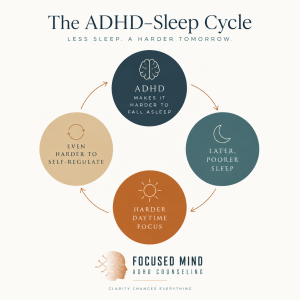
So, the answer to these questions is yes. ADHD impacts sleep, but poor sleep then impacts ADHD. Many adults with ADHD find themselves in cycles of poor sleep tied to lower mood, less productivity, and a loss of motivation.
What Helps ADHD and Sleep?
1. Brain Dump
At Focused Mind ADHD Counseling, we often hear that adults with ADHD can’t get their to-do lists out of their heads at bedtime. It’s as if sleep triggers worries about everything you didn’t do and have yet to complete. Consider getting these thoughts out of your head. Keep a notebook nearby and write down what you don’t want to forget.
2. Reduce Stimulation Before Bed
Lowering stimulation before bed often comes down to removing screens. Turn the TV off, put the phone far away from your bed, and get an alarm clock. Stop video game use an hour before bedtime.
3. A Calming Bedtime Routine
ADHD brains need a soft landing into bedtime. Think about it like this: bedtime starts an hour before bedtime. Take a warm shower, read a book, or listen to calming music. Start getting your brain ready to power down.
4. A Dark, Climate-Controlled Room
Roberto Olivardia, PhD, has explained the need for a calming environment to improve sleep. Consider an eye mask, earplugs, and making the temperature ideal for comfort. The stronger the environment around you says, “Go to sleep,” the more your ADHD brain will get the message.
Is Every Sleep Problem ADHD?
No, people can have sleep issues unrelated to ADHD. For example, insomnia, sleep apnea, restless legs, medications, and caffeine can all impact sleep. Sleep is vital to strong mental and physical health. A good starting point is bringing your concerns up with your doctor and mental health provider to explore what is what.
When Could Sleep Problems Be Part of a Bigger ADHD Picture?
As mentioned, sleep problems alone don’t indicate ADHD. If you’re curious about an ADHD diagnosis, look for broader, lifelong patterns:
- Distraction during the day
- Procrastination
- Disorganization
- Forgetfulness
- Impulsivity
- Time blindness

Comprehensive adult ADHD testing can help determine whether ADHD may be part of the bigger picture affecting your sleep. At Focused Mind ADHD Counseling, our evaluation process includes questions and screening measures designed to consider ADHD alongside other potential explanations for your symptoms, including sleep concerns.
When seeking ADHD testing in Columbus, Ohio, working with an ADHD specialist can help answer an important question: Is it ADHD, something else, or both?
Begin Adult ADHD Testing in Columbus, OH
Wondering if you have ADHD? You don’t have to live your life feeling foggy all day. Comprehensive ADHD testing can help you find answers. Our Columbus, OH, counseling practice has caring therapists who specialize in ADHD treatment. To start your counseling journey, follow these simple steps:
- Fill out the contact form to schedule a free 15-minute phone consultation.
- Meet with one of our caring therapists.
- Stop feeling dysregulated, turning your brain on and off, as needed.
Other ADHD Services Offered at Focused Mind ADHD Counseling
Adult ADHD testing is not the only service we offer at our Columbus, OH, counseling practice.
At Focused Mind ADHD Counseling, we offer a variety of mental health services, including ADHD treatment. As an adult with ADHD, you may also benefit from anxiety treatment for ADHD, counseling for men with ADHD, counseling for women with ADHD, ADHD-focused couples therapy, and depression counseling for ADHD. You can also view our blog for more resources and helpful info.
ABOUT THE AUTHOR
 Billy Roberts, LISW-S, LCSW, is the founder of Focused Mind ADHD Counseling and a licensed psychotherapist specializing in ADHD. Based in Columbus, Ohio, he provides ADHD testing and therapy to help adults better understand challenges related to time management, focus, emotional regulation, and relationships. He previously held a position at the NYU Child Study Center and has practiced as a psychotherapist for over a decade. His holistic approach to ADHD to assessment and treatment has been featured in Time Magazine,CNN, HuffPost, and Forbes, where he shares insights on helping individuals with ADHD manage their relationships, emotions, careers, time, and more. He is also the author of the upcoming book: Wired to Please: Unmasking the ADHD-People Pleaser.