

No matter how hard you try, time slips away. When you plan to stop a creative project, you realize you’ve lost hours. Even when you were sure you would be on time, the clock showed a different story. ADHD time blindness is one of the most frustrating yet overlooked parts of life with ADHD.
ADHD people have a complicated relationship with time. Years can pass, and we may or may not achieve our goals. People count on us to do things at a certain time and criticize us for things that feel beyond our control.
The research on ADHD and time is clear: adults with ADHD have shown difficulties across various dimensions, including estimating time, reproducing time intervals, and managing time.
While research has found variability across studies, the common thread is also clear: ADHDers march to a different drummer than they. Part of taking back control of your relationship to time is uncovering the nuances of time blindness itself.
What is Time Blindness?
ADHD time blindness is a term used to describe the brain’s difficulty accurately sensing and tracking the passage of

time. While everyone gets “in the zone” sometimes, people with ADHD may lose track of time more frequently, sometimes spending hours absorbed in or distracted by a task.
The prefrontal cortex of the brain houses the “executive functions,” which are the root of time blindness. ADHD has, by definition, executive functions that work differently than non-ADHD brains. In ADHD brains, dopamine regulation can be inconsistent, contributing to fluctuations in executive functioning.
The ADHD brain’s neural networks may struggle to communicate efficiently, contributing to difficulties with self-regulation, including accurately perceiving and managing time.
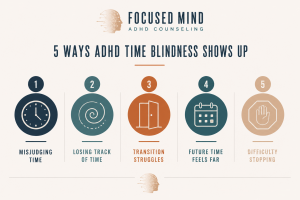
Five Hidden Ways Time Blindness and ADHD are Connected
1) Time estimation: “Why can’t I tell how long things take?”
Time blindness can also cause people with ADHD to miscalculate how long a task will take to complete.
A recent meta-analysis of 2,869 children/adolescents found significantly poorer timing accuracy and precision in ADHD.
When Daniel looked his boss in the eye, he was dead serious about finishing a project by Friday.
It wasn’t until he got started that he realized he was in over his head. There were minor tasks he forgot about—people he needed to get involved. And the hours spent rechecking his work.
Daniel felt awful about himself for his miscalculation. But Daniel didn’t have a problem with judgment; he struggled with time estimation, another form of time blindness.
2) Hyper-focus: “Why does time disappear when I work?”
Have you ever heard of a “flow state?” Those moments when you’re so in the zone you feel as though you’re flying? Many people with ADHD describe this as a superhuman ability.
Dr. Russell Barkley has explained that hyper-focus is another way in which people with ADHD struggle with dysregulation. Hyper-focus can cause a person to lose hours on tasks they find stimulating. While this can boost productivity on a single task, it makes task switching a genuine struggle.
When a person can’t switch tasks, their to-do list piles up. They can spend hours on something enjoyable, but not always as important as something else. For example, many people with ADHD will end up working outside of work hours because they lose time to hyper-focus during the day.
3) Transition time: “Why am I always late with ADHD?”
Tabby got to work nearly every day at 8:10 am. She was supposed to be there at 8:00 AM. Ever since her boss moved into the office across from hers, her reputation at work has been affected. She was in a panic. Until diagnosed with ADHD, Tabby didn’t know that part of time blindness is having a hard time managing the moment so you can show up on time for the future.
Tabby tried to be on time. But no matter what, something got in her way.
When it was time to wake up, Tabby either overslept or scrolled on her phone for too long. Even if she got up on time, she would get easily sidetracked when leaving the house. One more dish, one more text, oh look, the flowers need fresh water.
Suddenly, Tabby was leaving when it was time to be at work. Again. And her self-esteem plummeted.
Adults with ADHD struggle to manage their time. Part of time blindness is having a hard time managing the moment so you can show up on time for the future.
4) Future-time: “Why does ADHD make me underestimate time?”
Have you ever started a big project way too close to the deadline? People with ADHD can’t feel the future. People with ADHD don’t feel the urgency of next Friday until… next Friday.
Many adults with ADHD feel tremendous amounts of shame when they procrastinate. They spend hours with their inner critic, telling them they are “lazy” for procrastinating again.
But people with ADHD can’t always predict how long it will take to get things done. They need the external pressure of a fast approach deadline to get started. As Russel Barkely famously says to people with ADHD, there are two times: “now and not now.”
When planning your day or week, you might assume things will take less time than they actually do. So, if you run out of time faster than you run out of eggs, time blindness could be part of the problem.
5) Task-stopping blindness: “Why can’t I stop what I’m doing?”
As mentioned, people with ADHD have two times: now and not now. While hyper-focus can lead to long hours of laser-like focus on a task, stopping that task might feel…overwhelming.
In fact, many people with ADHD feel emotionally dysregulated when it’s time to stop a task. Their spouses might accuse them of snapping at them or seeming irritable. This is because our focus can become so intense that the brain can’t adjust quickly enough. It can feel as if you lose your flow; you’ll never finish.
How to Manage Time Blindness
Externalize time
Since the internal clock in an ADHD brain is off, externalizing time is key to managing time blindness. Here are two common ways to go about externalizing time:
- External clocks and reminders. Studies consistently show that externalizing time makes time management easier for people with ADHD. Some effective tools include using larger analog clocks, setting alarms, and using preset reminders on your phone to prompt you when you’re distracted.
- Externalize your calendar. The non-ADHD brain can remember what’s happening when. But if your brain only knows now and not later, it doesn’t have the luxury. To compensate, schedule everything. Literally everything. Whenever you make a plan, put it on the calendar. Be sure to check in with your calendar daily.
- Time blocking. Using your schedule isn’t just about appointments. You can also schedule tasks. Can’t find time to do your paperwork? Put it on the calendar and watch how the likelihood of you getting it done increases.
Boundaries

One way to manage time blindness is to manage your surroundings. Time blindness leads to overcommitment, which then leads to burnout. When stress increases, the brain’s executive functions become more drained. Enter more time blindness.
To set boundaries, start saying no more often. Look at your life, your relationships, and your job. Is there any safe place to say no? Spoiler alert: there always is.
Another way to set boundaries is expectation management. For example, do you say yes to every timeline and plan? Because managing time isn’t always about saying no. Sometimes it’s about saying yes with conditions. Can’t get the dishes done tonight because of a work project? Communicate that ahead of time and agree to do them tomorrow. Be sure to leave a Post-it note, of course.
Final Thoughts
Everyone with ADHD experiences time blindness. The key is learning the right time blindness strategies that work for you. Keep in mind, there is no one-size-fits-all approach to ADHD time blindness.
Remember: effective ADHD treatment will tailor all tools to your own unique brain for all things ADHD. That is the best way to build the best version of yourself and a life that works for you.
Begin Adult ADHD Testing in Columbus, OH
Wondering if your time management struggles are related to ADHD? You don’t have to live your life running behind without knowing why. Comprehensive ADHD testing can help you find answers. Our Columbus, OH, counseling practice has caring therapists who specialize in ADHD treatment. To start your counseling journey, follow these simple steps:
- Fill out the contact form to schedule a free 15-minute phone consultation.
- Meet with one of our caring therapists.
- Stop feeling blind to time and start feeling in charge of your time.
Other ADHD Services Offered at Focused Mind ADHD Counseling
Adult ADHD testing is not the only service we offer at our Columbus, OH, counseling practice.
At Focused Mind ADHD Counseling, we offer a variety of mental health services, including: ADHD treatment. As an adult with ADHD, you may also benefit from anxiety treatment for ADHD, counseling for men with ADHD, counseling for women with ADHD, ADHD-focused couples therapy, and depression counseling for ADHD. You can also view our blog for more resources and helpful info.
 ABOUT THE AUTHOR
Billy Roberts, LISW-S, LCSW, is the founder of Focused Mind ADHD Counseling and a licensed psychotherapist specializing in ADHD. Based in Columbus, Ohio, he provides ADHD testing and therapy to help adults better understand challenges related to time management, focus, emotional regulation, and relationships. He held a position at the NYU Child Study Center and has been a practicing psychotherapist for over a decade.
His holistic approach to ADHD to assessment and treatment has been featured in Time Magazine,CNN, HuffPost, and Forbes, where he shares insights on helping individuals with ADHD manage their relationships, emotions, careers, time, and more. He is the author of the forthcoming book: Wired to Please: Unmasking the ADHD-People Pleaser.