
Quick Read
- Many adults search “ADHD testing near me” after years of overwhelm, burnout, and productivity struggles.
- People often overlook ADHD in high-achieving adults, women, and anyone who has learned to mask their symptoms.
- A comprehensive ADHD evaluation looks beyond surface-level symptoms to understand executive functioning, emotional regulation, and daily life patterns.
***
Hit a breaking point? That’s often the moment adults struggling with chronic overwhelm, burnout, and productivity challenges look for answers. If you’re searching for “ADHD testing near me,” chances are you’re tired of struggling for years without effective support.
If you’re like many adults with undiagnosed ADHD, asking for help may not come right away. The moment arrives to call an ADHD testing practice, and you freeze up. You may worry about being misunderstood or overwhelmed by the intake process.
Not every mental health or medical provider specializes in ADHD. Understanding what to look for in ADHD testing can help you find the specialized support and answers you deserve — while also making the first step of reaching out feel much less overwhelming.
What is ADHD testing?
ADHD testing is a 2-3 hour evaluation that digs into ADHD symptoms past and present. You might wonder why not just take a quiz? While an online quiz is evidence-based for identifying symptoms, an ADHD evaluation explores the symptom timeline or whether another diagnosis is causing distress.
Because comprehensive ADHD testing is thorough, it can provide a more accurate diagnosis — along with a clearer roadmap for understanding your brain, improving daily functioning, and building a life that works better for you.
What leads adults to seek ADHD testing?
 Jennifer was at a tipping point. Her new promotion was burning her out. After years of working overtime to get ahead, Jennifer felt exhausted. It was time for a change.
She had been in therapy for a few years to work on anxiety. Still, she kept falling behind at work, felt overwhelmed, and struggled to be on time.
In fact, Jennifer had spent years in therapy for anxiety without feeling successful. As ADHD expert Dr. Roberto Olivardia notes, “Untreated ADHD will undermine treating any comorbid disorder.” Accurate identification and treatment of ADHD enable many adults to improve their mental health, self-understanding, and ability to function.
Many people with ADHD accept overwhelm as the status quo. When they learn ADHD is associated with forgetfulness, procrastination, and struggles with organization, something clicks.
Here are some common turning points that lead adults with ADHD to seek testing:
- A new job or promotion
- Starting adult learning (i.e., graduate school)
- New relationships (living with a partner without ADHD)
- The birth of a child (changes in hormones, routines, and responsibilities)
- Menopause (i.e., hormonal changes that intensify existing struggles with self-regulation)
Many adults with ADHD realize they may have ADHD when their usual ability to mask or cope with underlying struggles breaks down. Increased stress, burnout, life transitions, or growing responsibilities can make symptoms much harder to manage.
What to ask before ADHD testing
#1 Do you understand ADHD?
Obvious question, right? But how to ask it is less clear. Rather than asking it, it can help to have a couple of specific questions for them. For example:
- How do you assess someone who is high masking?
- Is there a way your testing ensures women with undiagnosed ADHD won’t go overlooked?
Another way to ask this question is by asking about credentials. You can ask about the person’s background, training, and what makes them credible. Most importantly, look for a specialist.
At Focused Mind ADHD Counseling, our entire practice specializes in researching, testing, and treating ADHD in teens and adults.
#2 What does ADHD testing consist of?
Be sure to ask about the testing process from start to finish. This is what to look for:
- Comprehensive. An ADHD test should be 2-3 hours (not 15 minutes).
- Multi-faceted. Testing for ADHD uses multiple data points to ensure no one is overlooked. For example, rating scales, cognitive testing, and a full medical and mental health history. All with particular attention to high-masking people like women, BIPOC, and high achievers.
- Efficient. Notice how quickly they return your call and how soon you can schedule. At Focused Mind ADHD Counseling, we use a state-of-the-art testing system to ensure we can schedule you within a couple of weeks, complete testing in one day, and deliver a report within a few business days.
#3 What does your ADHD testing report look like?
One main reason for ADHD testing is an official testing report. Your ADHD testing report confirms your diagnosis. It provides context to psychiatrists, doctors, and therapists to understand the difference between your ADHD, anxiety, or other factors that impact focus. This clarity ensures accurate treatment.
This report is between 20 and 30 pages long. It should include:
- Evaluation. What psychological tests did the testers use?
- Developmental history. Background information from childhood and young adulthood related to ADHD issues.
- Past and current functioning. A summary of the reasons you’re getting tested related to ADHD. This part of the evaluation is a comprehensive assessment of ADHD-related issues such as working memory, attention, time management, and impulsivity.
- Testing data. Psychological testing always includes numbers and explains them in easy-to-understand terms.
- Findings. An ADHD test comes with an official diagnosis. It explains how the data and your history support your having ADHD.
- Recommendations. An ADHD evaluation includes personalized recommendations for treatment, including medication, therapy, education, and accommodations.
Separating ADHD facts from fiction
ADHD myths can keep people from getting the help they need. For example, many adults delay testing because they assume they would have been diagnosed as a child or believe they can’t have ADHD if they’re successful. Learning to spot these myths can help you move past them and recognize red flags when others repeat them.
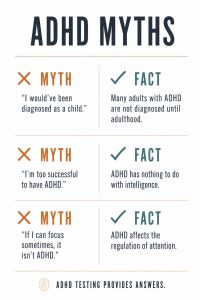
Myth #1: “If I had ADHD, doctors would have diagnosed me as a child.”
One study in 2004 found that doctors did not diagnose 75% of people with ADHD until adulthood. This points to generations of overlooked children with ADHD.
Many factors cause children with ADHD to go unnoticed during their childhood. Dr. Russell Barkley has discussed a concept called “impression management,” whereby people with ADHD learn to mask their symptoms from others. Children are no exception.
There are many situations where a child with undiagnosed ADHD can get good grades, please those around them, and still fly under the radar.
Myth #2: “If I’m successful, it can’t be ADHD.”
ADHD is a condition of executive functioning. This means it affects the brain’s ability to stay on task, get started, stay organized, and regulate impulses, to name a few.
ADHD does not relate to intelligence, talent, or perseverance. In fact, ADHD can sometimes contribute to a person’s success. The ADHD brain can become engaged and focused — when something feels stimulating, meaningful, or important. When people with ADHD find themselves in the right environment, they can become laser-focused and accomplish incredible things.
Myth #3: “If I can focus sometimes, it can’t be ADHD.”
Dr. Ned Hallowell has described ADHD as “a Ferrari brain with bicycle brakes.” The issue with ADHD isn’t that you can’t focus; it’s that you can’t regulate focus. Think of a superhero who can’t control their powers. Things are often out of sync until they find someone to help them understand and manage their unique strengths.
Enter ADHD testing.
The right questions lead to better answers
Many adults with undiagnosed ADHD research before scheduling an ADHD evaluation. This is a good thing. Being informed about the testing process and the provider you choose can increase the likelihood of an accurate diagnosis and recommendations tailored to your unique needs.
Begin adult ADHD Testing in Columbus, OH
Wondering if you have ADHD? You don’t have to live your life feeling out of control without knowing why. Comprehensive ADHD testing can help you find answers. Our Columbus, OH, counseling practice has caring therapists who specialize in ADHD treatment. To start your counseling journey, follow these simple steps:
- Fill out the contact form to schedule a free 15-minute phone
- Meet with one of our caring therapists.
- Stop feeling scattered and start finding real answers.
Other ADHD services offered at Focused Mind ADHD Counseling
Adult ADHD testing and teen ADHD testing are not the only services we offer at our Columbus, OH, counseling practice. At Focused Mind ADHD Counseling, we offer a variety of mental health services, including ADHD treatment. As an adult with ADHD, you may also benefit from anxiety treatment for ADHD, counseling for men with ADHD, counseling for women with ADHD, ADHD-focused couples therapy, and depression counseling for ADHD. You can also view our blog for more resources and helpful info.
About the author
 Billy Roberts, LISW-S, LCSW, is the founder of Focused Mind ADHD Counseling and a licensed psychotherapist specializing in ADHD. Based in Columbus, Ohio, he provides ADHD testing and therapy to help adults better understand challenges related to time management, focus, emotional regulation, and relationships. He held a position at the NYU Child Study Center and has been a practicing psychotherapist for over a decade. His holistic approach to ADHD to assessment and treatment has been featured in Time Magazine,CNN, HuffPost, and Forbes, where he shares insights on helping individuals with ADHD manage their relationships, emotions, careers, time, and more.