
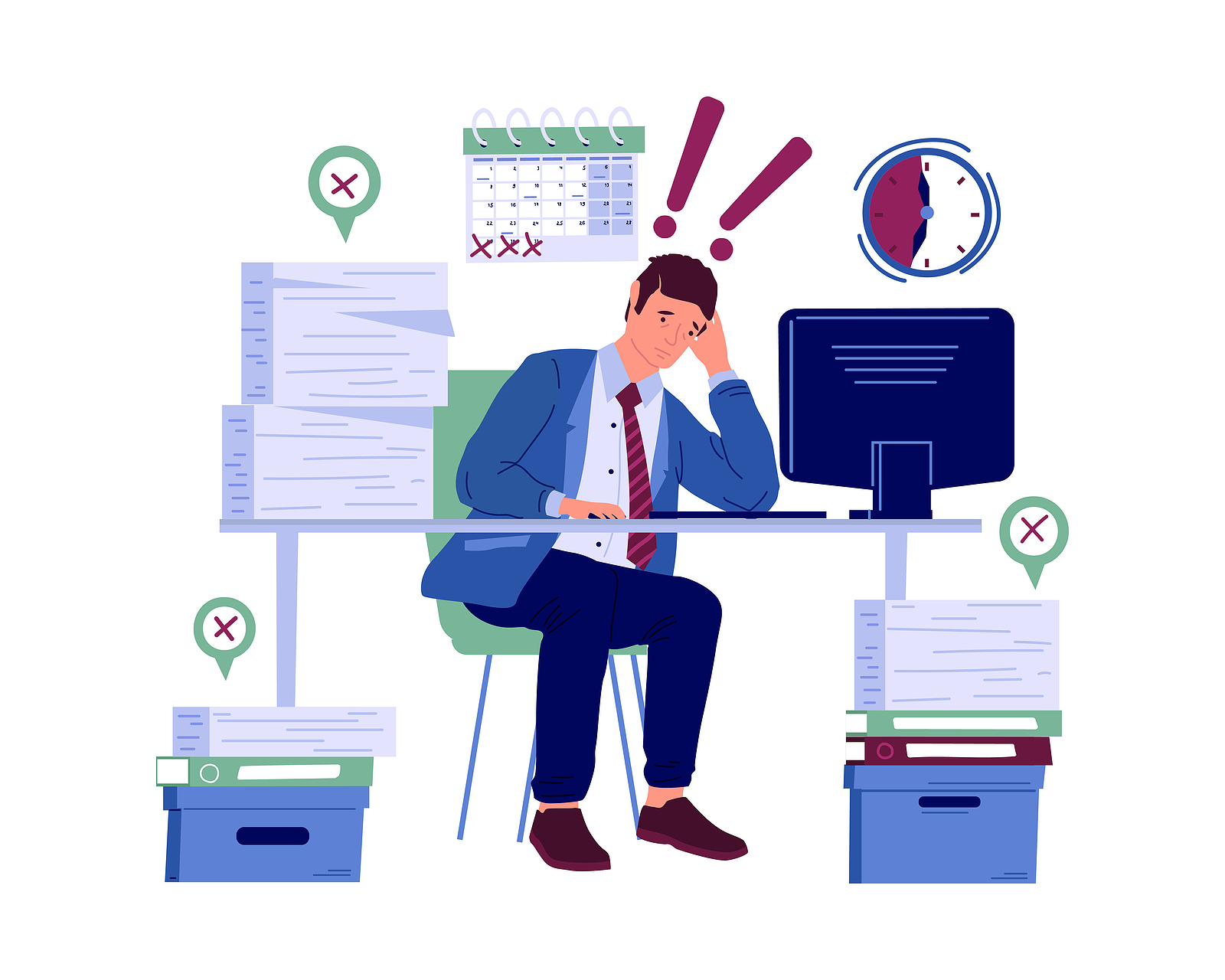
“What does your work history look like?” This is one of the most common questions asked during adult ADHD testing. There’s a reason: people with ADHD have a unique relationship to work.
If you’re curious about adult ADHD, exploring how your career history can help offer clues to an underlying adult ADHD diagnosis. For example, cycles of burnout, overcommitment, and hopping jobs because of boredom are common.
This article will provide concrete examples of clues that your work history may wind up answering the question: “Should I get tested for adult ADHD?”
Five Career Patterns That May Mean Adult ADHD
1. Workaholism
Despite feeling like they aren’t meeting their potential, research now suggests adults with ADHD work harder than their peers. The reason is a bit more complicated than it appears.
Above everything else, ADHD is a condition of dysregulation. We struggle to regulate our relationship to time, tasks, and emotions.
What does this look like in terms of our effort? It’s all over the place.
Many ADHDers spend hours in the evenings and weekends catching up. We do this for many reasons. For some adults, ADHD and time blindness can make it difficult to predict how long tasks will take, making them work later.
And then there’s hyper-focus. While many people think of ADHD as not enough focus, we often have too much. Many ADHD people get so locked into one task that others fall away. Sometimes, what falls off the list is family time, chores, hobbies, and anything but the task at hand.
2. Burnout
Have you ever hit a wall? A moment in life when you realize all the work you’ve done so far feels pointless. You may have even built a successful career but can’t shake the feeling that you’ve never reached your potential.

There are many reasons burnout is common in ADHD adults. One is that all the years of overcompensating seem to catch up with ADHD people. Another is that you’ve spent years doing what you “should do.”
But here’s the problem…
We live in a world of non-ADHD “shoulds.” Everyone has the answer: do something practical, pay the bills, etc. As you climb the ladder, you realize that life doesn’t feel much more satisfying in the middle or at the top. Turns out, it wasn’t the money and the promotion that your ADHD brain needed.
Rather, the ADHD brain requires something more meaningful. In fact, people with ADHD tend to thrive when they feel they are valued and uniquely contributing to work.
3. Executive Functioning Struggles
ADHD is a condition of executive functioning. The executive functions are a set of brain-based processes in the frontal lobe, and they tend to be impaired in adults with ADHD.
Here are some examples of executive functions:
-
Response inhibition (The brain’s ability to regulate behavior): This might look like reacting quickly to anger or frustration, making impulsive decisions or spending, or struggling to sit still.
-
Working memory (The brain’s ability to retain information until it’s needed): This might look like forgetting things people say, appointments, or misplacing things at work.
-
Procrastination (Delaying mundane or overwhelming tasks until the deadline): This often looks like putting work off until the last minute, needing a “crisis” to get things done, or never starting a project you’ve been thinking about for years.
-
Task switching (Getting distracted): We all get distracted sometimes. Adults with ADHD tend to truly struggle with staying on task. You might start on one thing, get on social media, lose an hour, find yourself somewhere else, repeat. At the end of the day, you wonder what more you might have gotten done if you could sustain focus.

While we all struggle with executive functions sometimes, adults with ADHD have patterns across their careers.
Think back. Has a boss or co-worker said anything about being more efficient? Better with time management and follow-through? Or have you yourself noticed such things? Situational executive dysfunction might mean stress. A pattern of dysfunction across time? That might mean a diagnosis of some kind.
ADHD therapy can help develop practical strategies for managing executive functioning challenges at work.
4. Career Switching and Job Hopping
Some ADHDers lose their job due to executive functioning issues. But some are so good at masking their ADHD, their bosses never realize they have ADHD.
On the other hand, many people with ADHD can’t help but get bored with their careers. They crave “the next.” The reason why lies within the ADHD brain.
ADHD brains struggle with dopamine regulation in the frontal lobe. The lack of sufficient dopamine makes us crave newness or creativity to start the engine. While this behavior can suit fast-paced jobs with novelty included, it can also cause many to change course entirely in pursuit of something new quickly.
5. ADHD Superpowers Collecting Dust
When Julie started her career as an executive, she was filled with hope. She loved having ideas and leading others. But as the reality of her new role settled in, she realized it sounded better on paper than in real life.
Julie wasn’t being creative. And she really wasn’t working with people in the way she hoped. Julie was making spreadsheets and getting lip service about the “numbers” from her boss.
Once Julie was diagnosed with ADHD, she realized that she needed to play to her strengths more. Julie had brilliant ideas and was beloved by her employees. It was time for Julie to take a more creative role again. Once she did, her burnout reduced, and her career expanded as her superpowers were being put to good use.
While ADHD does have disorder in the title, the reality isn’t that clear-cut. Having big ideas and a fast brain can also be useful. There will always be jobs better suited for brains that work differently.
Part of ADHD counseling is to find the best fit between workplace setting and ADHD superpower. As Julie realized, finding the balance between her brain and the world around her allowed her to find the best version of herself.
When ADHD Is a Part of the Bigger Patterns
For a diagnosis of ADHD, symptoms are lifelong. If you think back, it’s often the case that ADHD people put off their homework, struggle with time management, or are restless as kids. But keep in mind: ADHD can be masked growing up. Teachers, parents, and siblings can fill in the gaps and manage their time so well that no one notices the struggle.
Other factors include being gifted (intelligence can get the grade that no one notices) or being female (girls are overlooked because they are socialized differently than boys).
The point is: ADHD tends to pop up in various parts of life and in ways different for everyone.
What to Do if You Suspect ADHD
Another way to explore ADHD is through an evidence-based ADHD quiz. While not a diagnosis, it can validate the presence of executive dysfunction.
If an ADHD quiz is positive, it might be time to make a call to an ADHD specialist to schedule ADHD testing in Columbus, Ohio.
At Focused Mind ADHD Counseling, we start with an initial 15-minute phone consultation to explain our testing process. Our goal is to make the process as simple as possible.
Our state-of-the-art ADHD testing process is so efficient that we can get you scheduled within one week. Testing is completed in one 2- to 3-hour appointment, and results are provided on site. Within a week, you’ll receive a personalized report with recommendations for medication, therapy, and skills to manage ADHD.
Begin Adult ADHD Testing in Columbus, OH
Still wondering if you have ADHD? You don’t have to live your life feeling scattered and stuck without knowing why. Comprehensive ADHD testing can help you find answers. Our Columbus, OH, counseling practice has caring therapists who specialize in ADHD treatment. To start your counseling journey, follow these simple steps:
- Fill out the contact form to schedule a free 15-minute phone call.
- Meet with one of our caring therapists.
- Stop feeling distracted and overwhelmed and start finding focus and calm.
Other ADHD Services Offered at Focused Mind ADHD Counseling
Adult ADHD testing is not the only service we offer at our Columbus, OH, counseling practice.
At Focused Mind ADHD Counseling, we offer a variety of mental health services, including ADHD treatment, anxiety treatment for ADHD, counseling for men with ADHD, counseling for women with ADHD, ADHD-focused couples therapy, teen ADHD testing, and depression counseling for ADHD. You can also view our blog for more resources and helpful info.
About the Author
 Billy Roberts, LISW-S, LCSW, is the founder of Focused Mind ADHD Counseling and a licensed psychotherapist specializing in ADHD. Based in Columbus, Ohio, he provides ADHD testing and therapy to help adults better understand challenges related to time management, focus, emotional regulation, and relationships. He held a position at the NYU Child Study Center and has been a practicing psychotherapist for over a decade. His holistic approach to ADHD to assessment and treatment has been featured in Time Magazine, CNN, HuffPost, and Forbes, where he shares insights on helping individuals with ADHD manage their relationships, emotions, careers, time, and more. He is also the author of the book: Wired to Please: Unmasking the ADHD People-Pleaser.
FAQ Section
What is the process for booking an ADHD evaluation with a specialist?
To find a qualified specialist, look for credibility. For example, writing about ADHD or being aligned with organizations like ADDitude Magazine. Once credibility is verified, it’s worth it to speak with the person on the phone.
Ask questions about ADHD and their testing process. Look out for anything too brief. An adequate ADHD evaluation should take about 2-3 hours (rather than 20-30 minutes).
How to prepare for an adult ADHD assessment?
Self-reflection is the best way to prepare. Think about school and work history. Did anything you know about your executive functioning challenges today come up back then? Having examples is helpful in uncovering an ADHD diagnosis.
Are there therapists who specialize in ADHD and career counseling?
Yes, at Focused Mind ADHD Counseling, we understand the overlap between ADHD and career-related issues. Our ADHD specialists in Columbus, Ohio, are ready to help you navigate ADHD and career success.
Can your work history reveal undiagnosed ADHD on its own?
Your work history may provide clues about undiagnosed adult ADHD. Patterns such as frequent job changes, chronic burnout, overworking, and difficulty meeting deadlines can sometimes reflect underlying ADHD symptoms. However, these patterns alone do not confirm an ADHD diagnosis. A comprehensive adult ADHD evaluation can help determine whether ADHD or other factors are contributing to these challenges.