

The Quick Read
- ADHD can cause racing thoughts, mental restlessness, and difficulty shutting your brain off at night.
- Many adults mistake ADHD-related overwhelm for anxiety, stress, or burnout.
- Comprehensive ADHD testing in Cincinnati can provide clarity, same-day feedback, and a path toward effective treatment.
***
While most of us crave sleep, some of us can’t figure out how to do it effectively. Your head might hit the pillow, but your mind doesn’t get the message. The second the lights go out, your brain races over what you haven’t done, what you need to do, and all the things you wish you hadn’t said.
Dr. Ned Hallowell has described ADHD as “a Ferrari brain with bicycle brakes.” For many people with undiagnosed ADHD, this is one of the first ADHD symptoms they relate to: the complete inability to shut their brain off. This blog explores why the ADHD brain struggles to power down and how ADHD testing in Cincinnati offers an explanation and a solution.
What is a “Hyperactive Mind”?
You may have heard the term “hyperactivity.” But what does it mean, really? It’s not just 8-year-old boys racing around their classroom. In fact, up-to-date research on ADHD illuminates how hyperactivity can also be an inner experience. According to a recent study in PubMed, adults commonly experience “mental restlessness.” While many label this trait as anxiety or depression, mental restlessness is different.
Rather than relating to a single feeling state, a hyperactive mind also reflects dysregulation. In fact, Dr. Russell Barkley has described ADHD as a condition of self-regulation. This means the brain and body are often acting out of step with the situation. In the case of sleep, the bed says, “Go to sleep,” while the ADHD brain says, “Nope.”
Why Does Your Brain Get Louder at Night?
How dopamine shapes ADHD
Many newly diagnosed people with ADHD wonder: why does my brain race more at night? While dysregulation explains some issues, it’s not the full story.
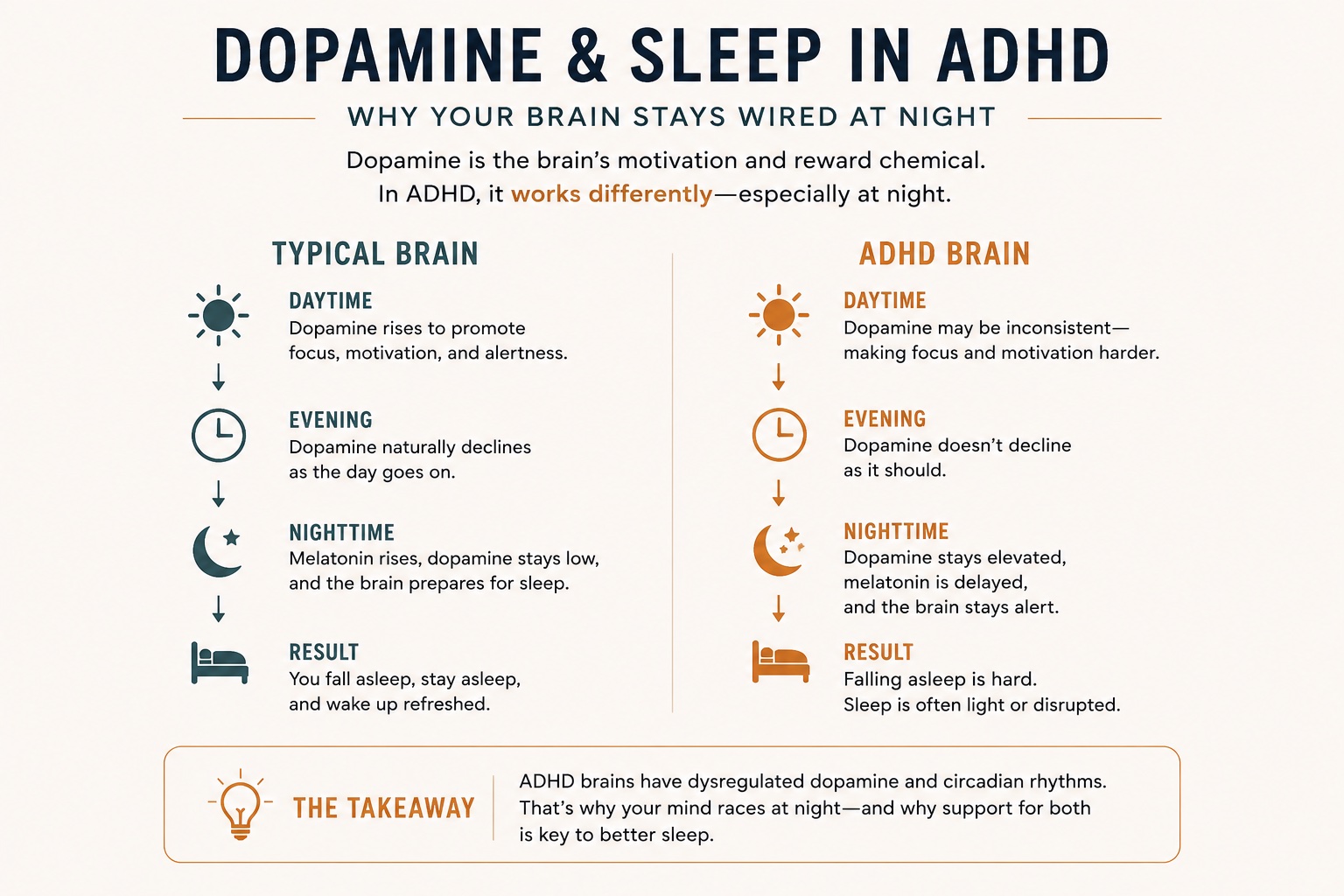 To understand hyperactivity and ADHD, you also need to understand why ADHD works the way it does. ADHD brains struggle with executive functions, including focus, sustained attention, internal motivation, working memory, and organizational skills, to name a few. The reason is that the dopamine system functions differently. ADHD brains simply don’t metabolize dopamine in the same way as non-ADHD brains.
Dr. Ned Hallowell describes ADHD as an interest-based nervous system. As a result, we seek out high novelty rewards, passions, and emotionally charged situations or stimuli to remain motivated and engaged. But there’s more….
A 2021 study found that dopamine regulation is directly related to circadian rhythms. It found that the dopamine system in ADHD brains contributes to irregular sleep patterns. That’s right: adults with ADHD struggle with falling asleep, staying asleep, and getting quality sleep.
Case example
Julie had tried everything. Medication, therapy, meditation, and even a sleep study. Nothing seemed to work in helping her shut her brain off at night. Finally, her sister, who had been diagnosed with ADHD, told her that she had the same issue, but that it was anxiety. Until she realized, she wasn’t just feeling worried at night; she was feeling everything.
Julie’s brain felt like an explosion of ideas, thoughts, and emotions. This caused daily overwhelm (adding to her restless mind at night). Not until she learned that ADHD runs in families did her sister’s diagnosis make more sense and make her realize that she herself could have ADHD.
Can ADHD Cause Constant Stress?
“ADHD is not a disorder of knowing what to do; it is a disorder of doing what you know.” — Russell Barkley.

Aside from mental hyperactivity, people with undiagnosed ADHD also tend to live stressful lives. There’s a sense of constant overwhelm. Think about forgetting appointments, working late to finish what you put off, and getting sidetracked all day; the emotional load of it all adds up. Come nighttime, it’s hard to feel you’ve “earned rest.” Many adults with ADHD review their days feeling guilty for every way they didn’t measure up. It’s torture.
Signs Your Racing Thoughts Might Be ADHD
It’s hard to tease out the difference between anxiety, stress, and ADHD. That’s where ADHD testing comes in. However, here are some common signs:
- Your brain feels busiest at night
- You replay conversations constantly
- You struggle to “earn rest” (so you don’t)
- Your mind jumps around between ideas, worries, and plans.
When Should You Consider ADHD Testing in Cincinnati?
There are many reasons adults with undiagnosed ADHD finally get tested. Here are a few:
- Struggling for years in therapy and struggling with the same issues with productivity, time management, etc.
- Shame and negative self-talk around ADHD-related issues (forgetfulness, etc).
- Marital issues or relationship struggles because of organizational differences, etc
- Not feeling like you’re meeting your potential
- Multiple unmet goals, hobbies, and projects
- Daily overwhelm
- Difficulties with sustained employment
Many people who are curious about ADHD take an ADHD quiz. These evidence-based scales can flag ADHD symptoms. While not enough for a diagnosis, they can usually offer the confidence to make a call to an ADHD specialist.
What Does ADHD Testing in Cincinnati Look Like?
Unlike a standard mental health evaluation, ADHD testing is comprehensive. It includes multiple rating scales, questionnaires, and neurological testing. ADHD testing includes a full interview that takes your social, medical, and mental health history.
By being comprehensive, we uncover symptoms that may be overlooked at first glance. For example, the nuances of how ADHD affects women (ie ADHD masking). After testing, we will provide feedback on your diagnosis. ADHD testing is unique in its ability to provide a plan of action. A step-by-step process for learning to shut your brain off (and all the other ADHD stuff in between).
Learning How to Slow Down an ADHD Brain
ADHD testing is only the start of learning to shut your brain off. Once doctors accurately diagnose ADHD, they can begin an effective treatment plan.
At Focused Mind ADHD Counseling, we see everyone as unique. No two ADHD brains are alike. This means we always personalize skills and tools for managing ADHD. That said, science has advanced rapidly over the past decade, and we’ve learned a lot about the ADHD brain. Here are some helpful tools to consider:
Creating an ADHD-Friendly Night Routine
 ADHD brains struggle to regulate from the inside out. As discussed before, the world says go to bed, and the ADHD brain says: no. This means that ADHD brains require us to signal to them what to do next.
As an ADHD specialist in Cincinnati, here are some evidence-based skills I recommend for starting a nighttime routine with ADHD:
Prepare for tomorrow, today
Because those of us with ADHD struggle with being forgetful, mornings can be a little hectic. This can actually cause stress the night before. Preparing what we need for the morning can help lower stress levels.
Avoiding conflict, TV, and, well, anything too stimulating late at night. Sometimes we can’t help but ramp up when our brains need to slow down. To better turn your brain off, give it less to stress about by avoiding stress too late at night.
A wind-down routine
ADHD brains benefit from a soft landing. Consider taking warm showers, listening to calming music, or listening to audiobooks. Whatever it is, be intentional about relaxation. Keep in mind that screen time is stimulating, so avoid using your phone too close to bedtime.
Meditation
Practicing meditation is another evidence-based way of calming a busy ADHD brain. Consider practicing meditation to calm and reduce stress. Starting with digital mediation apps is just fine; the key is to make it manageable so you are more motivated to practice.
Start moving
Exercise has a significantly positive effect on ADHD. Even a few minutes can lower stress, regulate emotions, and calm the nervous system.
ADHD brains often wonder: When will I find the time to work out? Try time blocking. Schedule workouts ahead of time. Furthermore, finding a way to stay motivated from the outside in also helps. Get a friend to go with you or join a class. The point is: make the commitment to the world around you.
Ready to Get Real Answers? ADHD Testing in Cincinnati, OH, Can Provide Them
Are your ADHD symptoms keeping you up at night? ADHD testing and therapy can help you find clarity. A professional ADHD evaluation can provide the certainty needed to move forward with effective support.
Our Cincinnati ADHD testing and therapy center offers both in-person and virtual assessments led by clinicians who specialize in adult ADHD. Through a structured and supportive evaluation process, we help you explore how ADHD symptoms may be affecting your work, relationships,
and daily responsibilities.
Here’s how to get started:
- Fill out our online contact form to request ADHD testing. A clinical director or intake coordinator will reach out to schedule a complimentary 15-minute phone call.
- Meet with an ADHD assessment specialist in Cincinnati who will guide you through the testing process and discuss concerns related to time management and focus.
- Receive clear diagnostic feedback and personalized recommendations, helping you move forward with therapy and strategies designed to improve time awareness and daily life.
You don’t need to keep struggling at bedtime as time slips away. The right assessment can bring clarity and help you develop tools that make daily (and nightly) life more manageable.
Other Services Focused Mind ADHD Counseling Provides in Cincinnati, Ohio
Understanding whether ADHD is contributing to your struggles can be an important step toward regaining a sense of control over your day. Through ADHD testing and ADHD therapy, many adults gain clarity about why planning and prioritizing feel so difficult and learn practical strategies to improve task initiation, follow-through, and quiet their brains at bedtime.
At Focused Mind ADHD Counseling, ADHD assessments are just one part of the support we provide. Our practice offers both in-person and online ADHD treatment for adults, including individual therapy that addresses the broader effects of ADHD, such as anxiety, depression, and relationship stress. Our clinicians work with clients to turn diagnostic insight into practical tools that support better organization, awareness, and emotional balance.
We also provide specialized counseling for men with ADHD, women with ADHD, teens with ADHD, and couples who are navigating ADHD-related challenges in their relationship. For ongoing learning and support, our blog features therapist-written articles and helpful resources that explore ADHD topics and offer strategies for managing everyday life more effectively.
About the Author
 Billy Roberts, LISW-S, LCSW, is the founder of Focused Mind ADHD Counseling and a licensed psychotherapist specializing in adult ADHD. Based in Columbus, Ohio, he provides specialized and comprehensive ADHD testing and ADHD therapy to help adults better understand challenges related to time management, focus, emotional regulation, and relationships. His ADHD-informed approach to assessment and treatment has been featured in Time Magazine, CNN, HuffPost, and Forbes, where he shares insights on helping individuals gain clarity about their symptoms and develop practical strategies for daily life.
FAQs
How long does ADHD testing take in Cincinnati?
At Focused Mind ADHD Counseling, ADHD testing takes about two hours, plus extra time for feedback.
Do you get ADHD test results the same day?
Yes! At Focused Mind ADHD Counseling, we can put all the pieces together by the end of testing. You will find out if you have ADHD the same day we test you for ADHD.
What type of doctor Is best for ADHD?
Licensed mental health care providers can diagnose ADHD. These include mental health counselors, psychiatrists, social workers, psychologists, and medical doctors. Beyond being licensed, seeing a person who specializes in ADHD is key.
How do I prepare for an ADHD evaluation appointment in Cincinnati?
Preparing for an ADHD evaluation appointment in Cincinnati is usually more straightforward than many people with ADHD think. The goal of comprehensive ADHD testing isn’t really to “pass a test.” The proper goal is to understand how your brain functions and whether ADHD may contribute to challenges with focus, stress, emotional regulation, organization, etc.
Here are some common ways to prepare:
- Be sure to complete the intake forms sent to you.
- Collect your thoughts in writing to increase your confidence that you’re saying all you’ve been thinking.
- Get a good night of sleep if possible
- Bring questions about ADHD. Remember, you’re seeing an ADHD expert who has knowledge to share.