

The quick read
- ADHD can make setting boundaries feel emotionally overwhelming due to rejection sensitivity and emotional dysregulation.
- Many adults with ADHD struggle with guilt, people-pleasing, and chronic overcommitment
- Mindfulness, self-compassion, and ADHD-informed coping skills can help make saying “no” easier.
***
Everyone online is saying: “Just set a boundary.” Sure, they make it sound so easy.
Have they met your boss? Do they know how much your friends are going through? For you, setting a boundary may have serious consequences.
But here’s the thing: ADHD brains struggle with setting boundaries for specific reasons unique to ADHD. For an ADHD brain, a boundary can feel terrifying. And the aftermath can make you feel like you committed a crime.
You know setting boundaries would help you, but the emotional roadblocks in your way feel too heavy to lift. This blog explores how to overcome those barriers and say no in an ADHD-friendly way.
Why does setting boundaries feel so hard with ADHD?
Executive functioning difficulties in ADHD
ADHD is a condition of executive functioning, which involves planning, self-regulation, follow-through, and working memory. These traits operate differently in ADHD brains; they vary depending on a person’s context, interest in a task, or passion for the activity. When people with ADHD struggle to say no, sometimes it’s a matter of forgetting or organizing one’s thoughts in the moment to know how to say no.
You might relate if:
- You make a plan to say no, but forget in the moment
- As you try to plan how and when to say no, you are overwhelmed with the steps
- Your mind goes blank in the moment, forgetting what you wanted to say
Rejection sensitivity makes boundaries feel unsafe
Do you fear rejection and negative feedback? It’s not a personality trait. In fact, most adults with ADHD struggle with Rejection Sensitive Dysphoria (RSD), an intense, wordless pain that intensifies fears of rejection (and the experience of rejection).
RSD causes people-pleasing, a tendency to put others’ needs before your own and give them what they want. You think that doing so will ensure they will not dislike you. In reality, RSD has the opposite effect, as you can become overloaded and burnt out trying to please others.
You might relate if:
- You panic when someone doesn’t text you back
- Avoid “putting yourself out there” or being yourself with others
- You people-please, giving others what they want so they won’t be mad at you
ADHD can cause overcommitment
Saying yes isn’t just a habit for people with ADHD; it’s a reflex. Many of us can’t help but agree to what our bosses, spouses, and friends ask of us. You think you’re going to the gym, but you’re taking over carpool for your husband instead. Sound familiar?
You might relate if:
- When you feel guilty for “dropping the ball,” you put more on your plate to make up for it
- When someone asks something of you, you forget to look at your own schedule or to-do list first
You grew up never feeling “good enough”
Many adults have low self-esteem. In fact, research shows adults with ADHD have much less self-compassion than those without ADHD. Where does this come from? Here’s a hint:
Self-esteem begins in childhood.
That’s right, and the reality is that kids with ADHD are always having to prove themselves to someone. But because it took them longer to learn the rules or the skills of the neurotypical world, there was a mismatch between expectations and what they could deliver. As a result, love can become conditional on their productivity.
In adulthood, you might constantly be seeking approval. When there’s a chance that asserting yourself might result in rejection, you’re likely opting out.
You might relate if:
- You are often looking to others to define your worth
- If someone hurts you, you’re unlikely to say anything
- You avoid conflict so as not to upset others
Emotional dysregulation makes conflict feel overwhelming
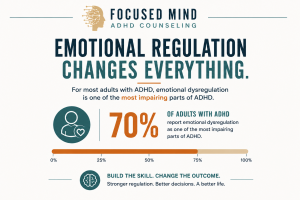 ADHD and emotional dysregulation go hand-in-hand. A 2017 study from PubMed explained that 70% of adults with ADHD report emotional dysregulation to be the one part of ADHD that impacts their goals the most. For most adults with ADHD, emotions come on suddenly and intensely. It can feel almost impossible to manage them at times. The intensity of big emotions causes many adults with ADHD to either get defensive, explode, or shut down entirely.
Boundaries can trigger anxiety spirals and intense feelings of guilt. And remember that whole not feeling good enough thing? That sure doesn’t help either.
You might relate if:
- You worry for hours (about having to set a boundary)
- When you set a boundary, you feel so guilty that you take it back
How to start saying no (minus the guilt)
Boundaries start with managing emotions
Dr. Russell Barkley has explained that emotional regulation is one part of ADHD that impacts everything. So, being aware of your own emotional state as a starting point for boundary-setting is a good first step.
By learning to be mindful of your emotions, you can manage your reactions to them. If your heart says “no boundary,” your mind can still say “yes boundary.”
Keep reading for evidence-based ways to start managing emotions.
Mindfulness of emotions
Emotional regulation starts with awareness. Practice being mindful of what you are actually feeling moment to moment. This works best to practice before those emotions regulate. Make it something you do daily. For example, are you feeling fear, shame, guilt, joy? The more you practice, the better you get at being aware of how you are feeling.
Meditation helps to slow things down
A 2025 systematic review/meta-analysis found that mindfulness-based intervention can be helpful in regulating focus and control for adults with ADHD.
Meditation is one way to practice mindfulness. Rather than just thinking about emotions, you can build awareness skills by focusing on any part of yourself. Being mindful of your body, your breath, or your thoughts helps build awareness.
Meditation also helps with accepting one’s emotional state without reacting. By identifying and accepting one’s emotions, one can choose behaviors aligned with one’s goals (e.g., setting boundaries).
Buy yourself time
A good way to build a stopgap between emotion and action is to buy yourself time. This can be very effective for ADHD boundaries at work. No need to say yes right away; have a script to circle back later. Here are some possible scripts for buying time:
- “Let me check my schedule.”
- “Can we circle back tomorrow?”
- “I may need a little time to scope that out before committing.”
Check the facts versus assumptions
Emotions don’t always run based on facts. Often, they are knee-jerk reactions to triggers based on past experiences. For example, if your boss emails you on a Friday night, the facts might not align with you getting fired. If you ask a co-worker a clarifying question, you might worry they will think you are “incompetent,” even if they don’t.
Here are some questions you can ask yourself to check the facts:
- What evidence do I actually have right now?
- Am I assuming how someone else feels?
- Could there be another explanation for this situation?
ADHD and self-compassion: learning to end self-blame
For many adults with ADHD, this can be especially difficult. Years of feeling “too much,” falling behind, or disappointing others often lead to deep struggles with self-worth. Setting boundaries can feel selfish. But the reality is: healthy boundaries are necessary for managing your time, energy, and emotional well-being. Every healthy relationship includes boundaries.
Once you begin to notice the guilt that comes with setting boundaries, the next step is to learn to validate your own needs anyway. This is rarely an overnight change. It’s an ongoing practice of treating yourself with more compassion instead of constant self-criticism. Self-compassion isn’t optional for people with ADHD; it’s essential.
Setting boundaries without losing yourself
At the end of the day, you don’t need to be a different person to set boundaries. There is a way to do it that is authentic to you. For example, honesty, relatability, and humor are just a few ways to be authentic and assert yourself in the world.
At Focused Mind ADHD Counseling, we help adults with ADHD create personalized plans to manage their time and relationships and find work/life balance by setting boundaries without losing who they are in the process.
Start setting boundaries with ADHD counseling in Columbus, OH
If you feel like you’re overwhelmed with overcommitment and poor boundaries, ADHD counseling or ADHD testing (if you’re not yet diagnosed) can help you better understand how to set boundaries. Many adults who struggle with boundaries realize that ADHD-related issues play a significant role, and a professional evaluation can provide the clarity needed to move forward.
Our Columbus ADHD testing and therapy center offers both in-person and virtual assessments led by clinicians experienced in adult ADHD. Through a thoughtful, supportive evaluation process, we help you explore how ADHD symptoms, including emotional sensitivity and stress responses, may be affecting your daily life and relationships.
Here’s how to get started:
- Fill out our online contact form to request ADHD testing or A clinical director or intake coordinator will follow up to schedule a complimentary 15-minute phone
- Meet with an ADHD specialist in Columbus, Ohio who will guide you through the evaluation process and discuss your concerns in detail.
- Receive personalized recommendations and create an individualized plan for therapy that works for you.
You don’t have to keep navigating setting boundaries on your own. The right assessment and counseling can help you better understand your experiences and build healthier ways to respond.
Other counseling services at Focused Mind ADHD Counseling in Columbus, Ohio
Understanding how ADHD contributes to boundary-setting can be a powerful first step toward change. Through ADHD testing in Columbus and/or ADHD counseling in Columbus, Ohio, many adults gain clearer insight into their emotional responses and learn practical strategies to manage criticism, self-doubt, and interpersonal stress more effectively.
At Focused Mind ADHD Counseling, ADHD testing and treatment is holistic. Our practice provides both in-person and online ADHD-informed services for adults, including ADHD testing and individual and group therapy that address the broader impact of ADHD on emotional regulation, anxiety, depression, and relationship dynamics. We focus on helping clients translate diagnostic insight into meaningful coping tools and healthier patterns.
We also provide specialized counseling for men with ADHD, women with ADHD, and couples navigating ADHD-related challenges in their relationship. For additional education and support, our blog features therapist-written articles and practical resources that explore ADHD topics, including emotional sensitivity and daily life challenges, to help clients better understand themselves and move forward with greater confidence.
About the Author
 Billy Roberts, LISW-S, LCSW, is the founder of Focused Mind ADHD Counseling and a licensed psychotherapist specializing in adult ADHD. Based in Columbus, Ohio, he provides ADHD testing and therapy to help adults better understand challenges related to time management, focus, emotional regulation, and relationships. His ADHD-informed approach to assessment and treatment has been featured in Time Magazine, CNN, HuffPost, and Forbes, where he shares insights on helping individuals gain clarity about their symptoms and develop practical strategies for daily life.